
When my husband Dale came home from his checkup last spring with a suggestion from his podiatrist, it sounded too plain to matter. Try non-binding socks, the doctor said. Dale has type 2 diabetes too, and the numbness in his toes has been creeping in over the last few years. He came home with that advice and a shrug. I came home with a research project. A few weeks later, a pair of Dr. Scholl's Men's Diabetic and Circulatory Non-Binding Cushioned Socks was in our laundry basket, and now I can tell you what three months of daily wear actually looks like.
The honest version of this review is not the version you usually see on product pages. The honest version starts with what these socks will not do. They will not reverse neuropathy. They will not bring feeling back to a numb toe. They will not replace the evening foot check that my podiatrist has drilled into me for years. What they can do is remove one specific, avoidable source of trouble: the tight elastic band that most socks leave around the ankle and calf. For a man whose feet swell a little by dinner and whose nerve changes dull sensation, that band is not a small detail. It is the difference between socks that leave deep red grooves and socks he forgets he is wearing.
The Quick Verdict
A plain, well-made sock that solves the tight-band problem without pretending to be medicine. Not flashy, not a cure, but genuinely comfortable for swollen, sensitive feet. The men's cut runs roomy, and they run warm in summer. We still buy them.
Amazon Check Today's Price →The Sock That Took Away Dale's Red Lines
If tight bands, red grooves, or irritated seams sound familiar, these are the socks we landed on after three months of testing. They are not a treatment, but they are a real improvement over the socks in most dresser drawers.
Amazon Check Today's Price on Amazon →How I've Used These Socks
I want to be clear about what my testing did and did not involve. I am not a doctor and I do not pretend to run a lab. I am a 63-year-old woman who has had type 2 diabetes for 15 years and neuropathy in both feet for about eight. The men's listing means these socks were tested on Dale, and I am reporting what he said along with what I watched happen.
Dale wears a men's size 12 wide and he is a big guy, so most socks are too tight somewhere on him by the end of the day. He wore these for about three months, six days a week, rotating the pairs we bought. He wore them around the house on our hardwood floors, on his morning walks, and under his work shoes when he was out in the garage. I washed them with the regular load in warm water and dried them on low.
Every evening I watched him take them off. That is the part that matters with neuropathy. I was not looking for comfort only. I was looking for marks, red lines, indentations, anything that could turn into a pressure sore without him feeling it. What I found was the most useful result of the whole test: after three months, the deepest mark these socks left on Dale's ankles was no mark at all.
One more thing about the testing. I tried a pair myself once, out of curiosity, because I also have neuropathy and I wanted to know whether the comfort was specific to Dale's feet. The men's cut was too roomy for me, which I expected. But even loose, the fabric was soft and the seam did not bother my toes. If the women's version fits the same way, I would wear it myself. I have not tested that one, so I will not review it. I am only saying the design made sense on my own skin.
First Impressions: What I Noticed the First Week
The first thing I noticed when the package arrived was how ordinary they looked. That is not a complaint. After 15 years of diabetes and eight years of neuropathy, I have learned to be suspicious of foot products that promise more than a sock can deliver. These promised nothing except a looser fit, and that is what they delivered. There was no dramatic first-wear moment. Dale put them on, walked to the kitchen, and said they felt like socks that fit.
The real difference showed up at the end of the day, not the beginning. His old socks left their mark by late afternoon. With these, there was simply nothing to see. No red line, no groove, no itchy band. The first week I checked his ankles every single evening, expecting the marks to show up eventually. They did not. That was the moment I stopped being skeptical.
What These Socks Actually Do, and What They Don't
Start with the label. Diabetic socks are a category, not a medicine. They are designed around the problems that diabetes tends to create in feet: reduced sensation, swelling, dry skin, and a higher risk of small injuries becoming serious. A sock cannot fix any of that. What it can do is stop adding pressure, friction, and moisture to the list.
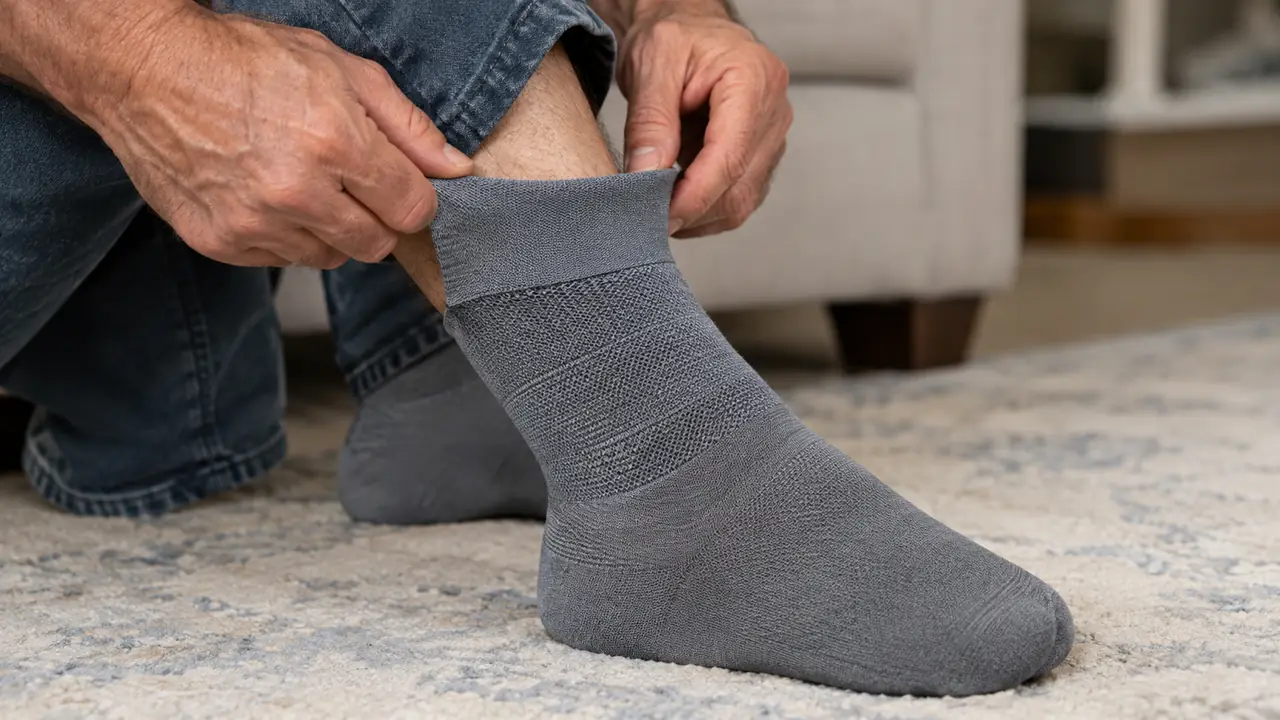
The Dr. Scholl's socks do three things well. First, the top of the sock does not squeeze. It is a looser, non-binding band that holds the sock up without digging in. Second, the sole has a layer of cushioning that softens every step on hard floors. Third, the toe seam is flat, so there is no ridge rubbing across the top of the toes. None of that is dramatic. All of it is useful.
Here is what they do not do, and this matters. These are not compression socks. People confuse the two all the time. Compression socks are tight on purpose and are used for specific circulation problems, usually prescribed or recommended by a doctor. These Dr. Scholl's socks are the opposite. They are loose where other socks are tight. If you need compression, these are not the sock for you, and you should ask your doctor before choosing any sock that squeezes.
Before I describe what he wore before, I should say that we were not starting from nothing. Dale's old socks were ordinary athletic socks from the big box store, and they fit him fine in the store sense. They were not too small and they were not worn out. They just had tight elastic at the top, which is true of almost every sock made. That is the whole point. Most socks are not bad socks. They are just built for feet that can feel them.
The Non-Binding Top: The Feature That Matters Most
Dale's old socks left a groove around his ankle by four in the afternoon. Some days the groove was deep enough that he could trace it with his finger after he took them off. For most people that is an annoyance. For someone with reduced feeling in the feet, it is a warning sign. A groove is pressure. Pressure that you cannot feel can become a sore that you cannot feel, and a sore that you cannot feel is how foot problems start.
The non-binding top works because it spreads that pressure instead of concentrating it. The band is still there, otherwise the sock would slide down, but it is wider and looser. Dale described it as the sock staying up without him noticing the top of it. That is exactly what you want. The best medical feature of this sock is that he forgets it exists.
One honest note: the looser top means the socks can slide a little inside a boot. Dale wears them under his work boots and said he had to tug them up once or twice on a long day. It was a small trade for no more grooves, and he got used to it. But if you live in boots, expect to adjust them.
Cushioning, Seams, and Life on Hardwood Floors
Our kitchen and hallway are hardwood, and Dale is a man who walks around in his socks all evening. The cushioned sole was the first thing he noticed. He said it felt like walking on a slightly softer floor, especially in the heel. For a man who spent his career on concrete shop floors, that is a real difference, not a marketing one.
The flat toe seam matters more than I expected. Dale used to turn his socks inside out because the seam bothered the tops of his toes. He stopped doing that with these. There is still a seam, but it lies flat and does not bunch. The toe box is also roomy, so his toes are not pressed together. That matters when the balls of the feet are numb and a tight shoe or sock is the only thing you would not feel.
The cushioning also changed how he walks around the house in the evening. He used to put on slippers right away because the hardwood felt hard under the heel. With these socks he often skips the slippers until the house gets cold. That sounds small, but for a man with early neuropathy, a little more padding under the heel is a little less shock on every step. I will take that.
The deepest mark these socks left on Dale's ankles after three months was no mark at all.
Three Months of Washes: How They Held Up
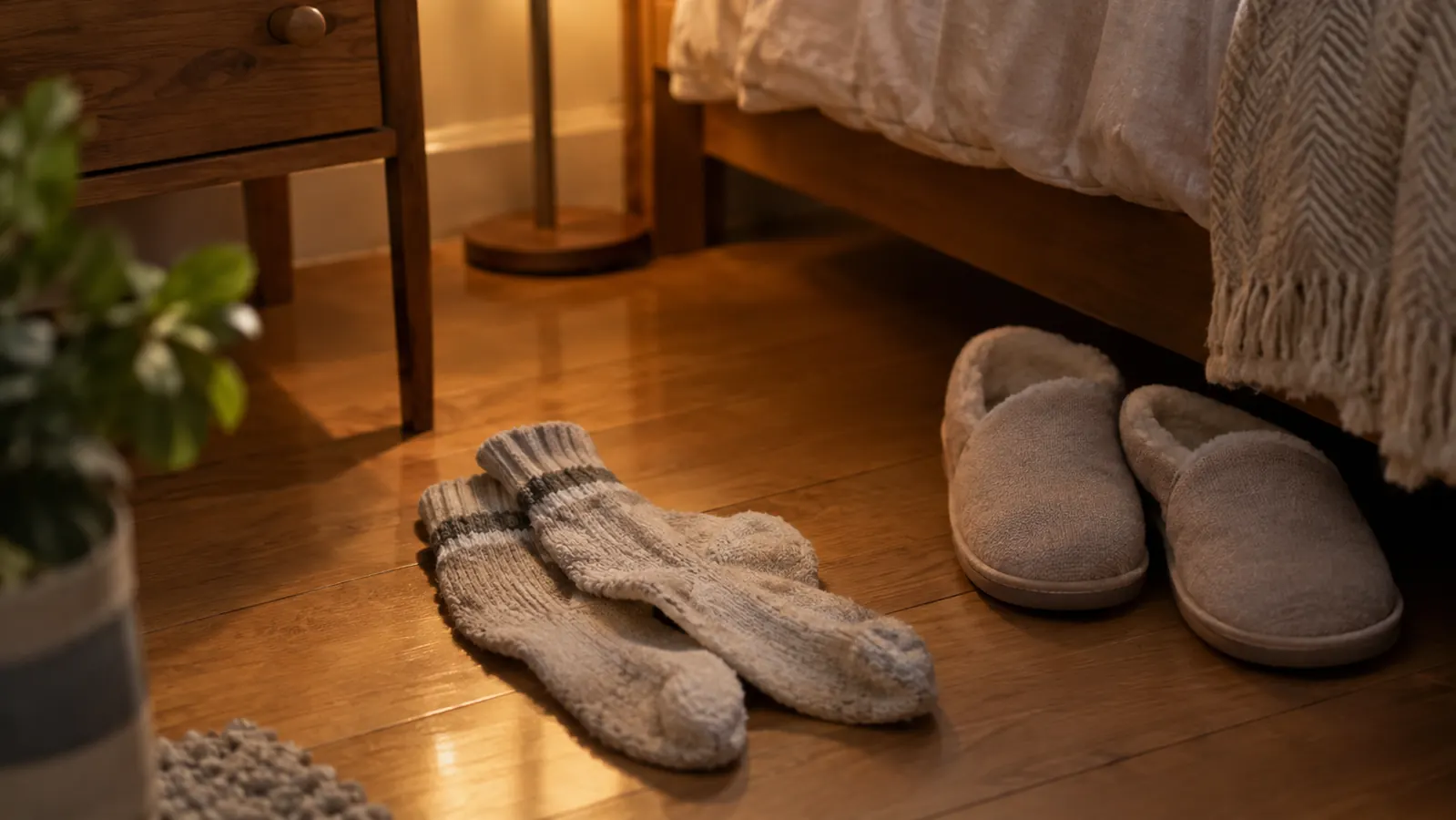
We washed these socks two or three times a week for three months. The pairs in our rotation have no holes, no stretched-out tops, and no loose threads. The cushioning in the heel has flattened a little on the pair he wears most, not enough to throw them out, but enough that I notice the difference when I compare them to a fresh pair. That is fair wear for a sock.
The other honest con is warmth. These are cushioned socks, and cushioned socks are warm. In Tulsa in July, Dale switched back to a thinner sock for the hottest weeks. If you live somewhere hot or your feet run hot at night, that is worth knowing before you buy a drawer full.
What I Liked
- Non-binding top leaves no red lines or grooves, even after a full day
- Cushioned sole is genuinely comfortable on hard floors
- Flat toe seam and roomy toe box, no irritation for sensitive toes
- Stays up without squeezing
- Held up well through three months of regular washing
Where It Falls Short
- Runs warm, so not ideal for hot summer months
- Men's sizing runs roomy, read the size chart carefully
- Heel cushioning flattened a bit on the most-worn pair
- Not compression socks, so they will not help if you need compression
What Nobody Tells You About Diabetic Socks
Here is the part that rarely makes it into the reviews. A sock with the word diabetic on the package is not a medical device and not a treatment. It is a well-designed piece of clothing. The label earns its keep only when it changes how the sock fits. A good regular sock with no tight band and a flat seam can do much of the same job. What matters is fit, not the word on the box.
The second thing nobody tells you is that these socks do not reduce your responsibility. I check my feet every evening with a hand mirror. Dale does the same, and I watch him do it. A comfortable sock does not mean you can skip that check. It means there is one less thing pressing on your feet while you go about your day. The check is still yours.
The third thing is sizing. Dr. Scholl's men's sizing runs roomy, and that is on purpose, but it caught me off guard. Dale's size 12 wide fit comfortably, and the socks were not tight anywhere. If you are between sizes, I would lean toward the smaller size and read the measurements on the listing rather than guessing by your shoe size.
The fourth thing is moisture. Cushioned socks are thicker, and thicker socks hold more sweat. Damp feet are a problem when you cannot always feel a developing hot spot. Dale changes socks if his feet get sweaty, and he lets them air out at night. I would say the same to anyone with neuropathy: dry feet are part of the routine, and a thick sock is only comfortable if you manage the moisture.
Finally, see your podiatrist on schedule. These socks came out of a podiatrist's suggestion for Dale, and that is the right order of things. A sock is a comfort and a protection. A doctor is the person who watches for the things a sock cannot fix. We keep both, and we would not skip either.
Who This Is For
These socks are for men with diabetic or circulatory foot trouble who get red lines, grooves, or irritation from ordinary socks. They are for people whose feet swell a little as the day goes on. They are for anyone with numbness who wants fewer pressure points and fewer seams pressing on sensitive toes. If you spend evenings walking around in socks on hard floors, the cushioning is a bonus you will feel immediately.
Who Should Skip It
Skip these if your doctor has told you to wear compression socks, because these are not that. Skip them if you have an open sore or a wound on your foot, and go straight to your podiatrist before you buy anything. Skip them if you have small or narrow feet, because the men's cut runs roomy and will likely feel sloppy. And if you live somewhere hot, you may want a lighter sock for the summer months and save these for fall and winter.
The Bottom Line
Here is where I land after three months. These are not the most exciting foot product you will ever buy, and they should not be. They are a well-made sock that removes one source of pressure from feet that cannot afford extra pressure. Dale wears them every day. I buy them again. If you have the same problem, the tight band at the end of the day, they are worth a try. If you are hoping for a cure for numbness, no sock will give you that, and anyone who says otherwise is selling something.
Fewer Grooves, Fewer Worries, Better Evenings
Three months in, these are the socks Dale reaches for first. They are not a cure for neuropathy, and no sock is. But they took away the red lines, and that is a real improvement we can feel and see. If tight bands have been bothering you, they are worth trying.
Amazon Check Today's Price on Amazon →